disneyhall

THE WALT DISNEY CONCERT HALL

Designed to look and feel like a ship's hull with flaring stainless steel curves, the Disney Hall, designed by famed architect Frank Gehry, opened in 2003. In addition to the 2,265 seat auditorium, the complex has two outdoor amphitheaters, an event space, a multi-use theater and an art gallery.

DLANC Bylaws

Adopted: July 29, 2002
Amended: March 26, 2006 
Amended: July 29, 2006 
Amended: March 11, 2008 
Amended: April 8, 2008

Articles

  1. Name and Organization
  2. Mission
  3. Purpose and Policy
  4. Definitions
  5. Membership
  6. Board of Directors
  7. Elections
  8. Standing Committees
  9. Meetings
  10. Boundaries
  11. Financial Accountability
  12. Ethics
  13. Amendments

Appendices

  1. Residential Area Map
  2. Business Area Map
  3. DLANC Board Rules of Order (Adopted: April 8, 2008)

Article I
Name and Organization

The name of this organization shall be the "Downtown Los Angeles Neighborhood Council." It may hereinafter be referred to as "DLANC."

Article II
Mission

The mission of the Downtown Los Angeles Neighborhood Council is to unite the diverse communities of Downtown Los Angeles and to provide an innovative forum for all community stakeholders to contribute to a healthy, vibrant, and inclusive Downtown neighborhood.

Article III
Purpose and Policy

  1. Purposes. The DLANC shall strive to unify and serve the interests of the Downtown community by:
    1. Creating an organization that truly represents the diversity of people and interests of Downtown;
    2. Developing an organization that interacts with the Downtown community and adjacent Neighborhood Councils by becoming a conduit for communication and by listening to and informing all who have interests in Downtown;
    3. Representing community interests in dealings with the City of Los Angeles and other government jurisdictions;
    4. Monitoring and communicating with city employees and departments that serve Downtown;
    5. Utilizing all city, county, state, and federal mandates to enhance the quality of life Downtown;
    6. Consulting with city officials regarding development plans Downtown; and
    7. Encouraging activities that highlight public safety, neighborhood beautification, residential and economic development, and historic preservation and renovation.
  2. Guidelines for Activity.
    1. The DLANC shall be recognized in all public announcements, statements, and communications, whether written, oral or electronic for activities and projects that it sponsors.
    2. Except as specifically approved by the Board of Directors of the DLANC, neither the DLANC nor its designees shall solicit or accept funds for any DLANC purpose.
    3. All activities must comply with local, state, and federal laws.
    4. The Executive Committee shall approve all communications for DLANC activities and projects and the Secretary shall retain a copy of each. Communications may include but are not limited to flyers, brochures, pamphlets, newsletters, posters, forms, e-mail announcements, and letters.
    5. The Executive Committee may review and approve any plan for distribution of such communications.
    6. The Executive Committee shall have the discretion to delegate to its agents any activities on behalf of the DLANC.
    7. The Executive Committee shall have the discretion to adopt any other rules of conduct that are deemed appropriate for DLANC activities and that do not conflict with the Bylaws and Mission Statement.
  3. Election of Directors. Directors shall be elected pursuant to Article VII.
  4. Transparent Operation. The DLANC shall adopt fair and open procedures for the conduct of its business, and shall make available to any party minutes of any meetings and any publications prepared or released by the DLANC.

Article IV
Definitions

  1. "Categories of Representation" refers to the three categories of interest used as a basis for Director election. The three categories are I) Residential, 2) Business, and 3) Arts, Culture and Educational Interests, Social Service Providers, Non-Resident Workforce, and At-large.
  2. "Board" refers to the Board of Directors, the governing body of the Downtown Los Angeles Neighborhood Council.
  3. "Business interests" are those interests whose members are engaged in for-profit activity, commercial activity, business associations, or business improvement districts in Downtown Los Angeles.
  4. "Community Stakeholder" or "Stakeholder" is anyone who lives, works, or owns property Downtown. Community Stakeholder is defined more completely in Article V.
  5. "Council" means, unless otherwise provided in these Bylaws, the Downtown Los Angeles Neighborhood Council.
  6. "Directors" are the elected members of the Board of Directors, the governing body of the Downtown Los Angeles Neighborhood Council.
  7. "Downtown Los Angeles Neighborhood Council" is that organization certified by the Board of Neighborhood Commissioners to function as a Neighborhood Council pursuant to the City Charter and Municipal Code of the City of Los Angeles.
  8. "Member" means any Stakeholder identifying himself or herself as a member of the Downtown Los Angeles Neighborhood Council.
  9. "Plan" refers to the Plan for a Citywide System of Neighborhood Councils."

Article V
Definitions

  1. Inclusive Membership. The DLANC shall be diverse, inclusive and open to all Community Stakeholders. A Community Stakeholder is defined as any individual who lives, works or owns property within the boundaries of the DLANC. In addition, Community Stakeholder status may be identified by participation in, among other things, educational institutions, religious institution community organizations or other nonprofit organization, block clubs, neighborhood associations, homeowners associations, apartment associations, condominium associations, resident associations, school parent groups, faith-based groups and organizations, senior groups and organizations, youth groups and organizations, chambers of commerce, business improvement districts, service organizations, park advisory boards, boys and girls clubs, cultural groups, environmental groups, code watch neighborhood watches, police advisory board groups, and/or redevelopment advisory boards.
  2. Statement of Non-Discrimination. The DLANC encourages all Community Stakeholders to participate in all DLANC activities. It may not discriminate in any of its policies, recommendations or actions against any individual or group on the basis of race, religion, color, creed, national origin, ancestry, sex, sexual orientation, age, disability, marital status, income or political affiliation.
  3. Dues. Fees and Assessments. No dues, fees, or assessments shall be required for membership in the DLANC.
  4. Grievance Procedure. Any stakeholder opposed to a procedural act or failure to act by the Board of Directors may submit a written grievance to any member of the Board. The Executive Committee or a sub-committee of the boards if so designated by Executive Committee, shall review the grievance at either a regular Committee meeting or a special Committee or designated sub-committee meeting. The person submitting the grievance shall be notified not less than four days prior to the meeting in order that he or she may attend and be heard. The Executive Committee or designated sub-committee shall resolve the grievance and take appropriate action and shall advise the person submitting the grievance of its determination.

    This formal grievance process is not intended to apply to Stakeholders who simply disagree with a position or action taken by the Board at one of its meetings. Those grievances can be aired at Board meetings. This grievance process is intended to address matters involving procedural disputes such as the Board's failure to comply with Board rules or these Bylaws, or its failure to comply with the City's Charter, the Plan, local ordinances, or state or federal law.

    In the event that a grievance cannot be resolved through this process, then the matter shall be referred to the Department of Neighborhood Empowerment for consideration or dispute resolution in accordance with the Plan.

  5. Voting age and the age of eligibility for Downtown Los Angeles Neighborhood Council board members and stakeholders shall be 16 years old, on or before the date of the Election.

Article VI
Board of Directors

  1. The Board of Directors shall consist of 28 members representing diverse sectors of interest and geographic locations Downtown as follows:
    1. 11 Directors shall represent Residents. Residents are tenants or homeowners who occupy their own dwellings. (39%)
    2. 8 Directors shall represent Business Interests. (29%)
    3. 3 Directors shall represent Arts, Cultural, and Educational Interests. (11%)
    4. 3 Directors shall represent Social Service Providers. (11%)
    5. 2 Directors shall represent the Workforce. (Sectors 3, 4, and 5 represent 7%)
    6. 1 At-Large Director shall represent any person who claims any type of stakeholdership in Downtown (4%)
  2. The basis for election of Directors to the Board of Directors shall be as follows:
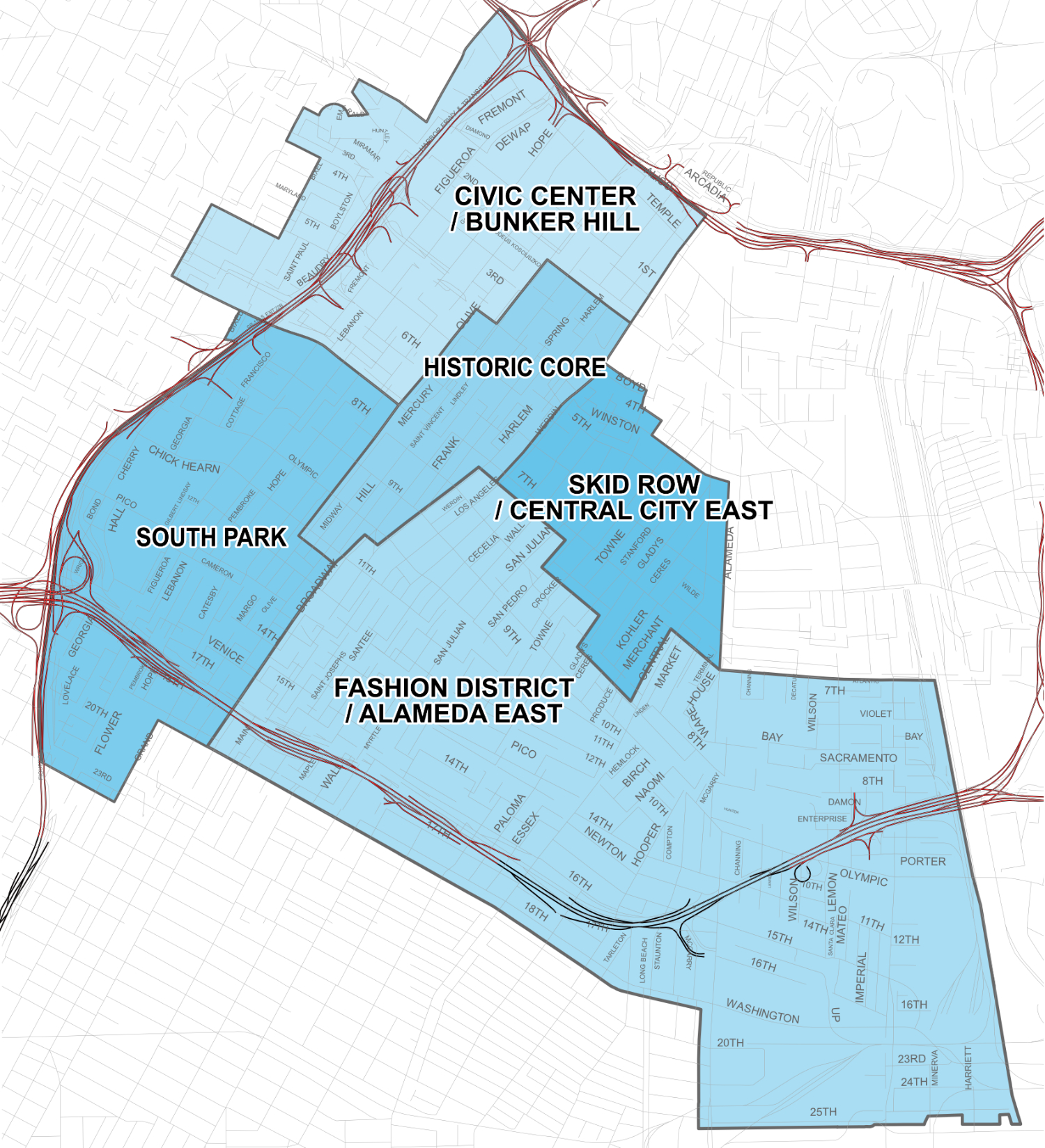
    1. Resident Directors shall include one Director elected by residents in each of the following geographic or community areas:
      1. Alameda East
      2. Bunker Hill
      3. City West
      4. Civic Center
      5. Central City East
      6. Fashion District
      7. Historic Downtown
      8. South Park
      9. Area-Wide Resident Artist
      10. Area-Wide Homeless
      11. Area-Wide Resident
    2. Business Directors shall include one Director elected by business members in each of the identified geographic areas, as follows:
      1. Alameda East
      2. Central City East / Toy District
      3. City West
      4. Downtown Center
      5. Fashion District
      6. Historic Downtown
      7. South Park
      8. Area-Wide
    3. Arts, Cultural, and Educational Interests shall include three Directors elected area-wide from organizations including but not limited to nonprofit educational institutions, museums, cultural institutions and organizations, preservation societies and organizations, faith-based organizations, and nonprofit entertainment venues. One of the Directors elected area-wide to represent Arts, Cultural, and Educational Interests shall be a professional artist.
    4. Social Service Providers shall include three Directors elected area-wide from entities including but not limited to mission-type organizations, faith-based organizations that provide social services, nonprofit affordable housing development and management organizations, nonprofit educational and employment training organizations, social service advocacy groups, nonprofit hospital and other health care providers, social service counseling organizations, and life enrichment organizations such as senior service centers.
    5. Workforce Directors shall be elected area-wide and include one person representing public sector employees and one person representing private sector employees. Workforce Directors may not be resident or business stakeholders.
    6. The At-Large Director shall be elected by everyone who holds any stakeholdership in Downtown
  3. Alternates.
    1. Each Board member shall have the ability to appoint their alternate, with approval by the Board of Directors. The Alternate will have voting authority when the Director is absent from board, committee, or other meetings of the Neighborhood Council. It is the responsibility of each Director to inform his or her Alternate in advance if the Alternate needs to attend any meeting.
  4. Officers and Duties.
    1. The Board of Directors shall elect the officers of the Board from among its members. Officers may be elected from any category of stakeholdership, and shall serve for a two-year term or until their successors are elected. The officers term will be coincident with the term of the Board of Directors. Elections of officers shall occur at the first meeting after the certified election.
      1. President.
        1. The President shall preside at all meetings of the Board and quarterly and special meetings of the Members; represent the interests of the Council before the City Council and City departments, boards, and commissions, or delegate such representation as warranted; serve as spokesperson for the Council in the press and before the public or delegate such a function as warranted; and Chair the Executive Committee.
      2. Vice President for Administration.
        1. The Vice President for Administration shall serve as President in the absence of the President; be responsible for the operational and logistical needs of the Board and Council; and Chair the Rules and Elections Committee.
      3. Vice President for Communication and Outreach.
        1. At the direction of the President, the Vice President for Communication and Outreach shall prepare and release media statements; prepare and release formal position papers; oversee the Council's web site; routinely inform the public of the Council's activities; actively solicit interest and participation in the Council's activities; and maintain a current roster of Members.
      4. Treasurer.
        1. The Treasurer shall Chair the Budget, Finance & Fundraising Committee. The Treasurer shall have charge and custody of and be responsible for the accounting of all funds of the Council; receive and give receipts for money due and payable to the Council from any source, and deposit such money in the name of the Council in such banks, trust companies, or other depository as shall be selected by the Board; separate bank, trust, or depository accounts shall be maintained for each type of appropriated fund or grant received from the City of Los Angeles through the Mayor and/or City Council; and in general perform all duties incident to the office of Treasurer and such other duties as may be assigned by the Board.
        2. The Treasurer and one other officer as designated by the Board shall have sole authority to co-sign checks of the Council. The Treasurer shall provide at each meeting of the Board and at such other times as the Board may request a written account of the finances of the Council. Additionally, the Treasurer shall provide financial statements for purposes of discussion by stakeholders at annual or special General Membership Meetings prior to submitting any accounting statements to the Department of Neighborhood Empowerment.
        3. The Treasurer shall prepare and file such documents and returns as are required by the Internal Revenue Service, the California Franchise Tax Board, and the City of Los Angeles.
        4. The Treasurer shall keep a book of accounts according to Generally Accepted Accounting Procedures, which book of accounts shall be made available for review by any authorized agency of the City of Los Angeles and by any stakeholder or member of the Downtown Los Angeles Neighborhood Council. The Treasurer shall cooperate fully with the Department of Neighborhood Empowerment on matters related to Council funding, financial affairs and accounting procedures, and shall allow Department of Neighborhood Empowerment staff access to the accounting records of the Council.
      5. Secretary.
        1. The Secretary shall keep a record of all proceedings, correspondence, and documents; at the direction of the President, prepare and post agendas of meetings; keep minutes of all Board, Board Committee, and Member meetings; keep a record of all persons wishing copies of agendas and minutes and supply such persons with copies of agendas and minutes.
    2. Board Committees. Except for the Executive Committee whose members are designated, the Executive Committee shall appoint four Directors to serve with the Chair on each of the Board Committees with the result that at least one but no more than two Directors by category of representation shall serve on each Board Committee.
      1. Executive Committee. The Executive Committee consists of the President as Chair, the Vice President for Administration, the Vice President for Communication and Outreach, the Treasurer, and the Secretary. The Executive Committee shall consider and recommend to the Board the location of Council offices, administrative policies and procedures for the conduct of the Council's business; the hiring and termination of employees and consultants; the Committee shall hear and act on grievances submitted pursuant to Article V., Section D.; in cases of emergency, shall act on behalf of the Board between Board meetings; shall authorize the application for, receipt, and expenditure of money from any source and for any lawful purpose; sponsor regular issues forums of interest to the Members; appoint Standing Committee chairs and members and adopt rules to govern the conduct of Standing Committees.
      2. Budget and Finance Committee. Chaired by the Treasurer, the Budget and Finance Committee shall approve the annual budget of the Council and have subject matter monitoring responsibilities over matters pertaining to the City Administrative Office, City Controller, City Treasurer, Office of Finance, Department of Fire and Police Pensions, Los Angeles City Employees' Retirement System, Quality and Productivity Commission, City Council Budget and Finance Committee, City Council Audits and Governmental Efficiency Committee. City management audits, financial audits, operational and performance audits.
      3. Rules and Elections Committee. The Rules and Elections Committee shall review and recommend proposed amendments to these Bylaws, conduct elections of Directors of the Board of Directors, and rules of conduct of Council meetings.
    3. Quorum. Fourteen Directors shall constitute a quorum. A majority vote of all Directors present shall be sufficient for the Board to take action.
    4. Resignation and Removal of Directors.
      1. A Director may resign in writing to the President or Secretary.
      2. Unexcused absence at two consecutive Board meetings or three Board meetings cumulatively in a fiscal year is grounds for expulsion of a Director from the Board. The President may excuse a Director if that Director provides a reasonable explanation of personal or professional grounds for his or her absence.
      3. A Director may be removed by the submission of a written petition which identifies the Director to be removed and describes in detail the reason for removal and includes the signatures of at least 100 Stakeholders. The Secretary shall then have the matter placed on the agenda for a vote of the Board at the next regular meeting of the Board. A vote of no confidence by an affirmative vote of 18 Directors, with a majority required from Directors representing each category of representation, shall be required to remove the Director from the Board. The Director that is the subject of the removal action shall not take part in the vote on this matter, but shall be allowed to speak at the meeting prior to the vote. If an adequate number of Directors is not present to take a vote on removal, the matter shall be placed on the agenda for the next regular meeting, and every meeting thereafter, until such time as a vote is taken.
  5. Rules of Order.
    1. Meetings of the Board, Board Committees, Standing Committees, and Annual Meetings of Members shall be conducted according to the DLANC Board of Director's Rules of Order, as most recently revised and attached to these bylaws, located in Appendix C, subject to the provisions of the Brown Act. Individual committees may adopt rules of order applicable to meetings of that committee, subject to ratification by the Board of Directors and in compliance with the Brown Act as applicable.
    2. Amendments to DLANC Rules of Order require a simple majority vote of the BOD pursuant to a motion of the Rules and Elections Committee.
    3. To the extent an issue is not covered by the DLANC Board of Director’s Rules of Order, Robert’s Rules of Order, as recently revised, shall be usd to resolve any such disputes.

Article VII
Elections

  1. Election and Term of Directors and Alternates.
    1. The City of Los Angeles, Office of the City Clerk will administer DLANC Board Elections
    2. Directors shall be elected for a two year term Each term shall commence on the first day of the month after the election. The election shall be close as possible to two years after the past election. Special elections shall be held by the relevant town hall meeting to fill any vacancy. No person shall serve as a Director for more than eight consecutive years.
    3. For DLANC board election for 2006, the election will be held the third quarter of the year. Following that, all future elections will be held in the second quarter.
    4. Alternate Directors. An Alternate Director shall replace his or her principal Director should the principal Director vacate his or her position on the Board.
    5. Vacancies. Should a vacancy occur in the principal Director and Alternate position for the same area and category of interest, a new Director and Alternate shall be elected within 30 days at a special town hall meeting in the area and category of interest vacated.

Article VIII
Standing Committees

  1. Standing Committees. Standing Committees shall consist of at least five Members appointed by the Executive Committee. Any Member of the DLANC may be appointed by the Executive Committee to any Standing Committee. It is the responsibility of each Standing Committee and each Board Committee with similar designated duties to:
    1. Monitor the proposed actions of the City Council committee or committees, and the proposed actions, programs, projects, and performance of the City departments, boards, and commissions for which each Standing Committee has subject matter jurisdiction;
    2. Invite City officials and others to Committee meetings and hear presentations on topics germane to the subject matter jurisdiction of the Committee;
    3. Consider recommending to the Board positions on proposed actions of the City Council and proposed actions, programs, projects, and performance of City departments;
    4. Report through its chair to the Board at Board monthly or special meetings on proposed City Council actions and proposed actions, programs, projects, or performance of City departments, boards, and commissions for which the Standing Committee has subject matter jurisdiction.
    5. With the approval of the Executive Committee, undertake special projects and programs to achieve desired City actions, civic improvements, or other matters relating to its subject matter jurisdiction.

Article IX
Meetings

  1. General Membership Meetings. General Membership Meetings shall be held at least once per calendar quarter.
  2. Special Meetings. A Special Meeting of the Members for any lawful purpose may be called at any time by the Board, by the President, or by a petition signed by 100 or more Members. The meeting date shall be at least 15 days but no more than 30 days after receipt of the petition by the Board. No business, other than the general nature of which was set forth in the notice of the meeting, may be conducted at such a meeting.
  3. Notice Requirements. Whenever Members are required or permitted to take any action at a meeting, a written notice of the meeting shall be given. The notice shall specify the date, time, place, and agenda of the meeting. All notices will conform to the Ralph M. Brown Act, which includes posting meeting notices in generally accepted public places, through electronic media, such as e-mail, and posting notice on the Council's web page and the web page for the Department of Neighborhood Empowerment.
  4. Brown Act. All meetings of the DLANC, including Annual Meetings, Special Meetings, Board Meetings, and committee meetings shall be conducted in compliance with applicable provisions of the Brown Act.

Article X
Boundaries

  1. External Boundaries.
    1. The external boundaries of the Downtown Los Angeles Neighborhood Council are as follows:
      • North -101 Freeway from Edgeware Road east to Los Angeles Street, south to 3rd Street, east to San Pedro Street, south to 4th Street, east to Alameda Street, south to 7th Street, east to the Los Angeles River.
      • East -Los Angeles River south from 7th Street to 25th Street.
      • South -25th Street at the Los Angeles River west to Alameda Street, north to Washington Boulevard, Washington Boulevard, west to Grand Avenue, south to 23rd Street, west to the 110 Freeway.
      • West -110 Freeway at 23rd Street, north to 8th Street, west to Bixel Street, north to Miramar Street, west to Emerald Street, north to 2nd Street, west to Edgeware Road, north to 1st, east to Beaudry, north to the 101 Freeway.
  2. Residential Boundaries. The boundaries for Residential Director election are as described in Appendix A.
  3. Business Area Boundaries. The boundaries for Business Director Election are as described in Appendix B.

Article XI
Financial Accountability

The Downtown Los Angeles Neighborhood Council agrees to comply with all financial accountability requirements as specified by City ordinance 174006 and in the Plan and as stated in the City's Certification Application. The Downtown Los Angeles Neighborhood Council further agrees to comply with all financial reporting requirements as prescribed by the Department of Neighborhood Empowerment.

Article XII
Ethics

The DLANC, its Directors, and all Stakeholders will endeavor to conduct Council business in a professional and respectful manner. The DLANC is committed to developing a system whereby pertinent information transmitted through the City's Early Notification System will be disseminated or made available in a timely manner to every Stakeholder. The Council, its Directors, and all Stakeholders will refrain from violating Board rules and shall abide by the Plan and all City, County, State, and federal laws that apply.

Article XIII
Amendments

These Bylaws may be amended by an affirmative vote of 18 Directors, with a majority vote required from Directors representing each category of representation. All amendments to the Bylaws require the approval of the Department of Neighborhood Empowerment.

Appendix A
Residential Boundary Map

Appendix A - Residential Map

Appendix B
Business Boundary Map

Appendix B - Business Map

Appendix C
DLANC Board Rules of Order

Rules of Order exist to facilitate the decision-making process at meetings. They ensure that discussion is clear, and that the rights of both the majority and the minority are protected. Below are some of the basic rules that help a meeting run more smoothly and keep discussion on track. The rules, however, are not meant to disrupt or hold-up a meeting, and may be suspended by a majority vote of the Board if a member is using them for those purposes.

  1. President - Board Meetings. Each meeting of the Board of Directors is facilitated or guided by a chair, who shall be the DLANC President or a designated DLANC officer, in the event that the President is not in attendance. The chair of a General Meeting shall not vote expect in case of a tie. S/he is responsible for ensuring that the meeting runs smoothly and fairly. The chair at general meetings leads the discussion and helps facilitate discussion among members. The chair does not make motions at General or Special meetings, and does not vote, except in the event, after a vote has been taken, that his/her vote would be the vote decider. After discussion of motions among members, the chair supervises the vote or agreement on consensus.
  2. Committees & Committee Chairs. Standing committees are the regular, consistently operating committees of the general body. Special or ad-hoc committees may be developed for a shorter-term purpose which has a definite end. The structure of committee meetings is more informal. The committee chair may take part in the discussion and voting at the committee level. Committees are advisory to the Board of Directors; any recommendation or motion from a committee for action by DLANC requires ratification by the Board of Directors.
  3. Main Motion. The basis for debate is a formal motion. The motion is put forward or 'moved' by a voting member of the Board to focus discussion. Each motion must have a mover and a seconder to show that it has at least a minimum of support from the Board. If there is no second for a motion, the motion dies and no discussion takes place. Once a motion has been seconded and put 'on the floor' for debate, debate must focus on the substance of the motion. All other discussion is out of order and should not be allowed except for discussion after a motion to amend has been made and seconded. A main motion may not be introduced if there is any other motion on the floor. The mover must state the motion or write it out and hand it to the chair for reading if necessary so that everyone is clear on what is being discussed. For a main motion to be adopted, unless otherwise specified in the Bylaws, a simple majority vote in favor of the motion is required.
  4. Order for Main Motions & Discussion. Once a motion is introduced and seconded, the chair will maintain a speaker's list to allow for discussion in an orderly manner. The maker of the motion is first to speak on behalf of the motion. The order is up to the chair, including the amount of time to speak. A member may yield their time or position on the floor to another member. At the end of the discussion, the maker of the motion is given an opportunity to speak again as the last speaker before a vote is taken on the motion. A new motion cannot be introduced until the present motion under discussion is amended, adopted, tabled or defeated.
  5. Amendments. At any time, a person who has the floor during discussion of a main motion can introduce an amendment to the main motion being debated. A “friendly amendment” may be made to a main motion, only if the maker of the main motion, and the seconder of the main motion are agreeable to the revision. Otherwise, a motion must be made, seconded and adopted to make an amendment to the main motion. An amendment is a motion that alters, adds to, or subtracts from the main motion. Amendments to motions must have a direct bearing on the original motion, and may not include new subject areas. Amendments must also be moved and seconded. Once an amendment has been moved and seconded, debate is held on the amendment only – not on the main motion. If further revision of a main motion is necessary, it is best to ask the maker to withdraw the motion and begin with a new main motion. For an amendment to be adopted, a simple majority vote in favor of the amendment is required. Once an amendment has either been adopted, defeated, or withdrawn, discussion reverts back to the main motion, taking into account whether the motion has been altered due to an approved amendment. Complex or lengthy amendments should be written out for the chair to be able to read back to the membership.
  6. Point of Order. If a member feels that the rules of order are being broken, s/he can immediately raise a 'point of order', and state what rule has been broken or not enforced by the chair. A point of order can interrupt a speaker. It cannot be used as an opportunity to get around the speakers' list - it can only be used to ask the chair to enforce the rules. The chair decides if the point is valid or not, and proceeds accordingly.
  7. Point of Privilege. A point of privilege can interrupt the speaker. A member who feels her/his right or privileges have been infringed on may bring up this point by stating their problem. Privilege refers to anything regarding the comfort of accessibility of the member (i.e. too much noise, etc.), or to the right of the member not to be insulted, misquoted, or deliberately misinterpreted. Again, the chair decides if the point is valid or not and proceeds accordingly.
  8. Point of Information. A point of information is a QUESTION. A member may interrupt the speaker to ask her/his question, but the speaker who has the floor has the privilege to refuse the question. The chair will ask the speaker if s/he wishes to entertain a question at that time. A point of information is not an opportunity to bring forward information, jump the speakers' list, or generally disrupt the proceedings.
  9. Table. Debate may end in several ways. If a member feels that a decision on a motion needs to be postponed for some reason, then s/he can move to 'table' the motion. A member may not move to table a motion at the end of a speech, only at the beginning of the time they are recognized by the chair. A specified time may be put on the tabling or the motion may be left “on the table” indefinitely. The only debate allowed on a motion to table is as to the length of tabling. A motion to table requires a simple majority in favor of the motion.
  10. Calling the Question. If a member feels that further debate is unproductive, s/he may 'call the question', requesting the debate be ended. This can be done by any speaker who has the floor at any time in the discussion. The chair recognizes the "call" and asks if there are any objections, at which time anyone may say "objection". If there is no objection, the meeting proceeds to the main motion vote without further discussion. If there is objection, then the members vote on whether to end debate or continue. This vote requires a two-thirds (2/3) majority to be approved, and is non-debatable. If the 'call' is approved, a vote on the main motion is immediately taken without any further debate.
  11. Taking the Vote / Announcing Results. Votes are conducted by the chair and can be taken either verbally "All in favor say 'aye'... All opposed say 'nay'"; or by show of hands; or written by secret vote, if such discretion is required and the members agree to conduct a secret ballot. Motions are decided in one of three ways and the result should be clearly announced after the vote by the chair. The result of a vote on a motion can be one of three things. Motions are either adopted/approved (majority says yes), defeated (majority says no), or tied, at which time the chair votes to break the tie. Motions which receive a vote are not "passed", or "lost" or "won". A passed motion is one for which the subject is tabled before a vote is called. A lost motion is a motion which obtains no second.
  12. Adjourn. This motion takes precedence over all others, except to 'fix the time to adjourn', to which it yields. It is not debatable and it cannot be amended. A motion to adjourn cannot be made when another has the floor, nor after a question has been put and the assembly is engaged in voting.

Appendix D
Rules of Order — Quick Guide

  1. How are Motions Presented?
    1. Obtaining the floor
      1. Wait until the last speaker has finished
      2. Raise your hand to alert the chair that you wish to speak
      3. Wait until the chair recognizes you
    2. Make Your Motion
      1. Speak in a clear and concise manner and state a motion affirmatively.
      2. Say, "I move that we ..." rather than, "I move that we do not ...".
      3. Avoid personalities and stay on your subject. While making the motion is not the time to give discussion in support of your motion. You will have a chance to speak during discussion, and as maker of the motion will get the last word before the vote.
    3. Wait for Someone to Second Your Motion
      1. Another member will second your motion or the chair will call for a second.
      2. If there is no second to your motion it is lost.
    4. The Chair States Your Motion If Necessary
      1. The chair will say, "it has been moved and seconded that we ..." Thus placing your motion before the membership for consideration and action.
      2. The membership then either debates your motion, or move directly to a vote.
      3. Once your motion is presented to the membership by the chair it becomes "assembly property", and cannot be changed by you without the consent of the members.
    5. Discussing / Debating Your Motion
      1. The time for you to speak in favor of your motion is after it is presented and seconded.
      2. The mover is always allowed to speak first, and then in order according to the chair.
      3. All comments and debate should be directed to the chair.
      4. Keep to the time limit for speaking that has been established.
      5. The chair may call upon the mover or another speaker to answer a question if one comes to the floor.
      6. The mover may speak again as the last speaker after other speakers are finished to summarize or reiterate a point of choice. It is not mandatory that the mover speak again, it is his/her prerogative.
    6. Putting the Question to the Membership
      1. The chair states the motion, including all approved amendments, and asks, "Are you ready to vote on the question/motion?"
      2. If there is no more discussion, a vote is taken and the results announced by the chair.